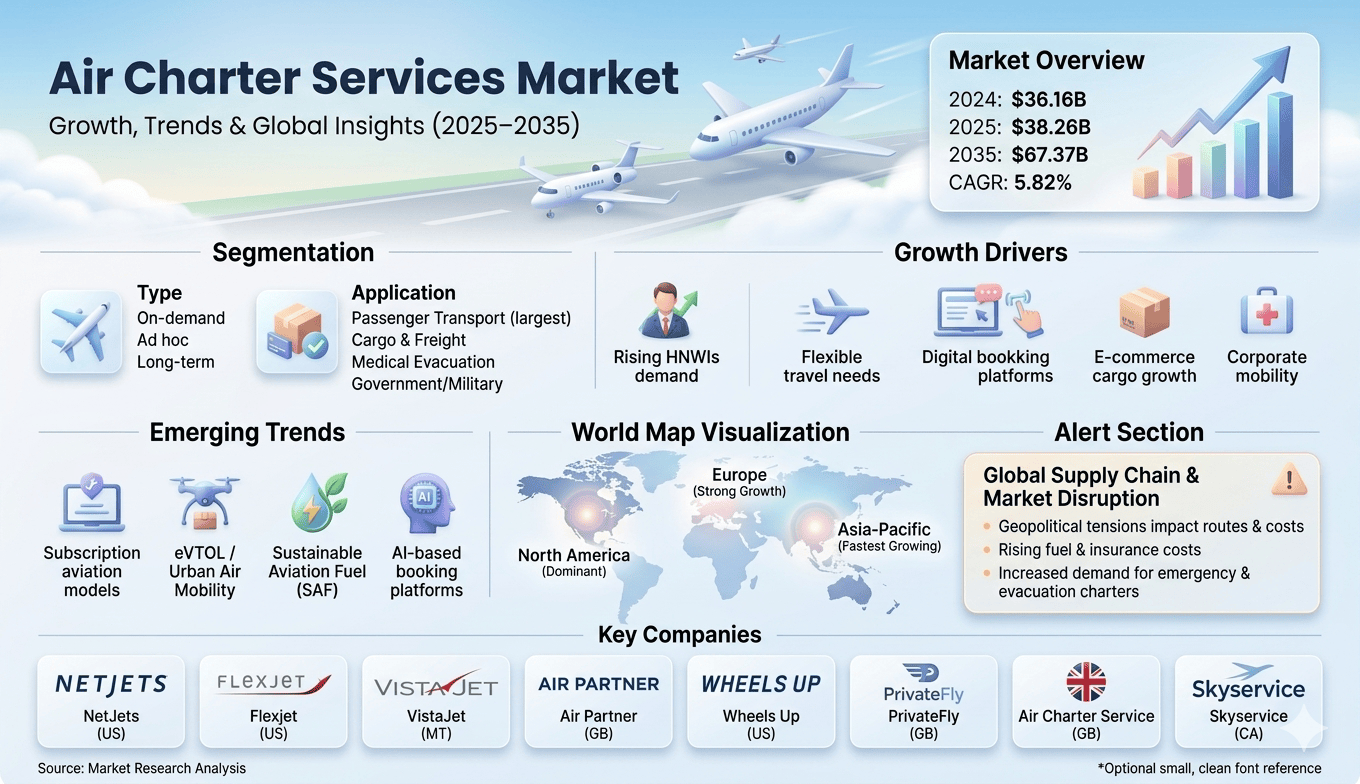
The global Air Charter Services Market was valued at USD 36.16 billion in 2024 and is projected to reach USD 38.26 billion in 2025, expanding further to USD 67.37 billion by 2035, at a robust Compound Annual Growth Rate (CAGR) of 5.82% during the forecast period from 2025 to 2035. This impressive growth trajectory reflects the surging global appetite for flexible, on-demand aviation solutions catering to business executives, leisure travelers, cargo operators, and humanitarian organizations worldwide. As commercial airlines continue to face capacity constraints and scheduling rigidity, air charter services have emerged as a premium yet increasingly accessible alternative, offering unparalleled convenience, time efficiency, and customized travel experiences tailored to the unique needs of each client.
Key Companies Shaping the Market
The air charter services landscape is highly competitive, populated by a mix of global giants and regional specialists. Prominent players profiled in this market include NetJets (US), Flexjet (US), VistaJet (MT), Air Partner (GB), Charter Jet One (US), JetSuite (US), Wheels Up (US), PrivateFly (GB), Air Charter Service (GB), and Skyservice (CA). These companies are continuously innovating their service offerings, expanding fleet capacities, and investing in digital platforms to attract and retain high-value clientele. VistaJet and NetJets, for instance, have pioneered subscription-based and fractional ownership models that democratize access to private aviation, while Wheels Up has built a membership-driven ecosystem appealing to a broader audience. Competition among these players is driving improvements in safety standards, customer service, and route coverage.
Regional Analysis
Geographically, the air charter services market spans North America, Europe, Asia-Pacific (APAC), South America, and the Middle East & Africa (MEA). North America continues to dominate the market, underpinned by a well-established business aviation infrastructure, high disposable income levels, and strong corporate demand for private travel. The United States alone accounts for a significant share of global charter activity, with demand emanating from financial hubs, entertainment capitals, and oil-producing states. Europe follows closely, with the UK, Germany, France, and Switzerland serving as key demand centers, especially for luxury tourism and cross-border business travel. The APAC region is the fastest-growing market, driven by the rapid rise of high-net-worth individuals (HNWIs) in China, India, and Southeast Asia, alongside growing investment in regional airport infrastructure.
Segmentation Analysis
The market is segmented by Type, Application, and Region, allowing a nuanced understanding of demand patterns across different verticals. By type, the market includes on-demand charters, ad hoc charters, and long-term contract charters, with on-demand services gaining significant traction due to their flexibility. By application, the market serves passenger transport, cargo and freight, medical and emergency evacuations, and government or military uses. Passenger transport remains the largest segment, while medical evacuation services have seen a notable uptick post-pandemic. The cargo segment is experiencing robust growth, propelled by e-commerce expansion, time-sensitive pharmaceutical shipments, and supply chain diversification strategies pursued by multinational corporations seeking resilience against logistics disruptions.
Impact of Geopolitical Tensions and War on the Air Charter Services Industry
| GLOBAL SUPPLY CHAIN & MARKET DISRUPTION ALERT
Escalating geopolitical tensions in the Middle East, particularly around the Strait of Hormuz and the Red Sea, are creating significant disruptions across global energy, chemicals, and logistics markets. Critical shipping corridors are under pressure, with major oil, LNG, petrochemical, and raw material flows at risk, triggering supply chain delays, freight cost surges, insurance withdrawals, and heightened price volatility. These disruptions are increasing operational risks and cost uncertainties for industries dependent on global trade routes and energy-linked feedstocks. |
Ongoing conflicts and geopolitical instability across the Middle East, Eastern Europe, and parts of Africa have had a complex, dual-edged impact on the air charter services industry. On one hand, war zones and sanctioned airspaces have forced commercial airlines to reroute flights, significantly increasing travel times and costs — creating a window of opportunity for private charter operators to offer direct, sanctions-compliant routing alternatives. Humanitarian agencies and multinational corporations operating in conflict-affected regions have increasingly turned to chartered aircraft for rapid personnel evacuation, medical supply delivery, and emergency logistics. On the other hand, rising jet fuel prices linked to energy market volatility, insurance premium hikes for overflying conflict zones, and airspace closures have elevated operating costs for charter service providers. Operators serving routes near the Red Sea and Eastern Europe are particularly exposed to route disruption risks, prompting many to reassess fleet deployment strategies and build contingency cost buffers into client contracts.

Key Growth Factors
Several macroeconomic and industry-specific factors are fueling the sustained expansion of the air charter services market. The primary driver is the rising global demand for personalized and time-sensitive travel experiences, as wealthy individuals and corporations increasingly value control over schedules, onboard privacy, and the ability to reach secondary airports closer to final destinations. The growing global population of HNWIs and ultra-high-net-worth individuals (UHNWIs) is a structural demand driver, as private aviation remains a preferred mode of travel for this demographic. Additionally, the post-pandemic normalization of remote work and distributed business models has blurred the line between personal and professional travel, prompting more organizations to invest in charter solutions for team travel, client entertainment, and executive mobility.
Technology integration is another pivotal growth enabler. The proliferation of digital booking platforms, mobile applications, and AI-powered itinerary optimization tools has dramatically lowered the friction of chartering an aircraft. Companies such as PrivateFly and Wheels Up have pioneered app-based instant quoting and booking, making private aviation more transparent and accessible. Blockchain-based payment systems and dynamic pricing algorithms are further modernizing the market. Moreover, the cargo charter sub-segment is benefiting from the boom in express e-commerce deliveries, vaccine distribution logistics, and semiconductor supply chain urgency, particularly in Asia-Pacific and Europe. Sustainability concerns are also pushing operators toward investing in SAF (Sustainable Aviation Fuel) compatible fleets and carbon offset programs, aligning with ESG mandates of corporate clients.
Emerging Trends in the Air Charter Services Market
Several emerging trends are reshaping the competitive dynamics of the air charter services market. The rise of subscription and membership-based aviation models is democratizing access to private flying, allowing a broader customer base to enjoy charter benefits at predictable costs. Fleet modernization is accelerating, with operators retiring aging turboprops in favor of fuel-efficient mid-size and super-midsize jets that offer superior range, cabin comfort, and lower emissions. Urban Air Mobility (UAM) and the anticipated integration of electric vertical take-off and landing (eVTOL) aircraft into the short-haul charter space represent a forward-looking trend with significant long-term implications. Operators are also expanding their geographic footprints into underserved markets in Africa, South Asia, and Latin America, leveraging charter services to bridge connectivity gaps where commercial airline networks remain thin. ESG compliance, crew welfare, and digital customer experience are rising to the top of executive agendas across the industry.
Q1. How does the air charter services market differ from commercial aviation, and what advantages do charter services offer?
Air charter services differ fundamentally from commercial aviation in that they involve the rental of an entire aircraft for a specific journey, rather than purchasing individual seats on a scheduled flight. This model offers significant advantages including complete schedule flexibility — clients depart and arrive at times of their choosing, not the airline’s. Charter passengers can use a wider range of airports, often smaller regional facilities much closer to their actual destination, avoiding major hub congestion. Onboard privacy, customized catering, and the ability to hold confidential business discussions mid-flight are additional benefits. For cargo operators, charter services allow dedicated freight capacity without competing with passenger baggage, making them invaluable for time-critical or oversized shipments.
Q2. What role does sustainable aviation fuel (SAF) play in the future of air charter services?
Sustainable Aviation Fuel (SAF) is becoming a critical strategic consideration for air charter service operators as corporate clients intensify their ESG (Environmental, Social, and Governance) scrutiny of travel expenditure. SAF, produced from waste materials and renewable feedstocks, can reduce lifecycle carbon emissions by up to 80% compared to conventional jet fuel. Charter operators are increasingly offering SAF-powered flights as a premium option or incorporating it into standard offerings to meet client sustainability mandates. Several leading charter companies have entered long-term SAF procurement agreements with fuel suppliers to ensure supply continuity and price stability. Regulatory frameworks across the EU and North America are also mandating progressive SAF blending targets, making early adoption a competitive differentiator for charter operators aiming to retain environmentally conscious corporate and HNWI clientele.
Read Our Related Report:
Charter Jet Service Market Research Report –
https://www.marketresearchfuture.com/reports/charter-jet-service-market-35674
Aircraft Video Surveillance Systems Market Research Report –
https://www.marketresearchfuture.com/reports/aircraft-video-surveillance-systems-market-68272
Aircraft Switches Market Research Report –
https://www.marketresearchfuture.com/reports/aircraft-switches-market-9705
Aircraft Recycling Market Research Report –
https://www.marketresearchfuture.com/reports/aircraft-recycling-market-14010
Aircraft Evacuation Equipment Market Research Report –
https://www.marketresearchfuture.com/reports/aircraft-evacuation-equipment-market-38347
© Market Research Future. All rights reserved.